Open to buy for boutiques: the formula, a worked ₹ example, and the mistakes that give a false green light
TL;DR:
- Keep every figure on the same basis, all at cost or all at selling price. Mixing the two overstates what you can buy, because selling prices typically run 40 to 60% above cost.
- Forgetting to subtract stock already on order is the most common mistake, and it inflates OTB by exactly the value of those orders.
- If you are GST-registered, count stock at cost before GST, because you claim the GST back as input credit. If you are not registered or are on the composition scheme, include GST in cost.
- Recalculate monthly for steady categories and weekly for fast-moving or promotional ones.
- Work OTB out per category before adding it up. A healthy store total can hide one category that is already overbought.
Table of Contents
- What is open to buy in retail, and why does it matter?
- How do you calculate OTB step by step?
- Does GST go into the OTB calculation?
- How should retailers build OTB into a planning process?
- Should you calculate OTB by department, category or channel?
- What mistakes cause OTB figures to drift from reality?
- When does OTB tracking need software instead of a spreadsheet?
- Keeping stock on order accurate
- Why OTB discipline takes longer to embed than the formula suggests
- Sources
- FAQ
What is open to buy in retail, and why does it matter?
Open to buy is a budgeting tool that tells you how much you can spend on new stock without overcommitting your cash. It is a spending ceiling, not a target. Shopify describes it as an inventory budgeting strategy that calculates what a retailer can afford to purchase during a set period, after subtracting what is already on hand and already on order. Most retailers trip up on that difference between a ceiling and a target: they treat OTB as money to spend, when its job is to stop them spending more than the business can absorb.
The standard OTB formula, used across apparel, home goods and most general retail, is:
OTB = Planned sales + Planned markdowns + Planned closing stock − Opening stock − Stock on order
Each term does specific work:
- Planned sales is what you expect to sell in the period, at your chosen valuation basis.
- Planned markdowns covers stock you expect to discount, for clearance, festive offers or end of season.
- Planned closing stock is the stock you want on the shelves and in the back when the period ends.
- Opening stock is what you are already holding when the period starts.
- Stock on order is everything already ordered but not yet delivered.
The formula only works if every input uses the same basis. RetailNorthstar's formula guide is explicit: all figures must be at either selling value or cost value, never mixed. Selling value suits a store planning against a sales target. Cost suits anyone whose main worry is cash flow, because it reflects what you actually pay suppliers.
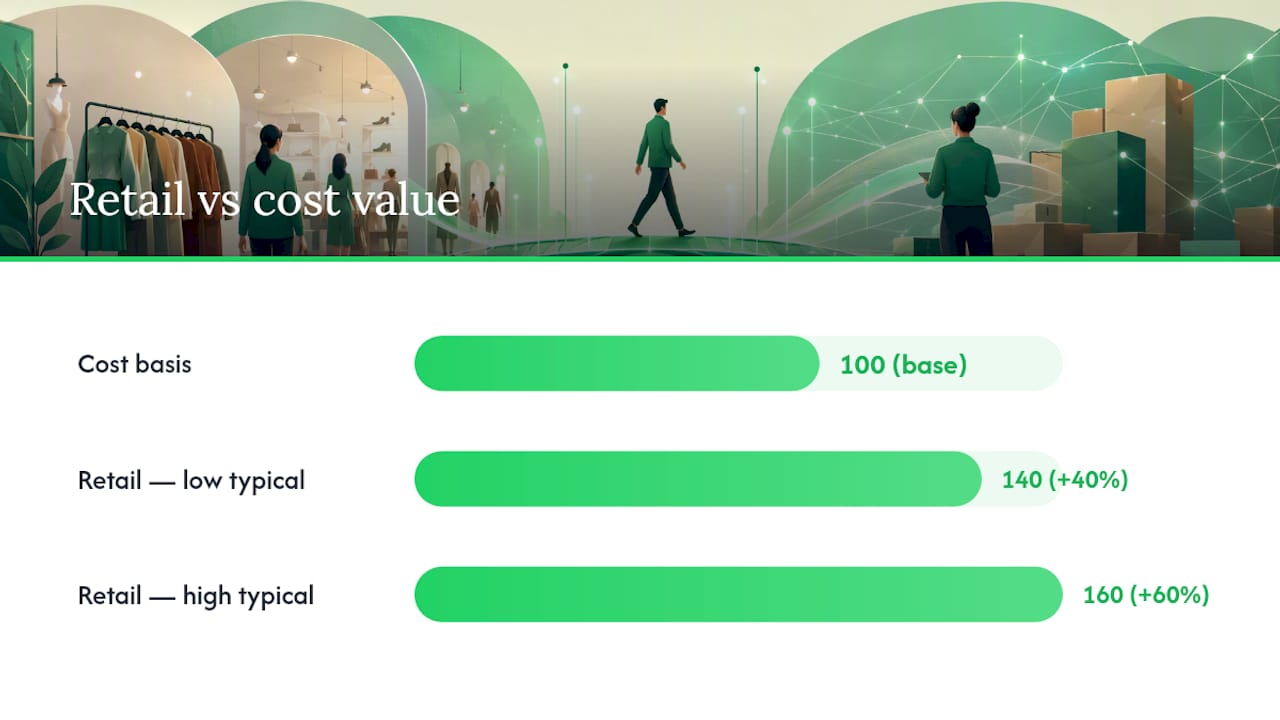
Why mixing bases is dangerous: it is not a small rounding error. Selling prices typically run 40 to 60% above cost for the same goods, so one figure at the wrong basis can turn an OTB that is really negative into a false green light.
How do you calculate OTB step by step?
Take the kurtis section of a boutique for one month, with every figure at cost:
- Planned sales: ₹1,80,000
- Planned markdowns: ₹15,000 (clearing last season's slow styles)
- Planned closing stock: ₹2,20,000 (about five weeks of forward sales, enough to carry you into the festive rush)
- Opening stock: ₹2,60,000 (what is on the rails and in the back today)
- Stock on order: ₹90,000 (orders placed with suppliers but not yet delivered)
OTB = ₹1,80,000 + ₹15,000 + ₹2,20,000 − ₹2,60,000 − ₹90,000 = ₹65,000
That ₹65,000 is what you can commit to new orders for kurtis this month without breaking the stock plan. If the same sum had come out at minus ₹30,000, your stock and open orders would already exceed what the plan supports. The right response is not a smaller order anyway: RetailNorthstar notes that a negative OTB signals over-commitment and calls for cancelling open orders, delaying deliveries, or reforecasting sales and markdowns rather than pushing ahead with new buys.
Zero sits in between: you are exactly on plan, with no room to add stock until sales bring inventory down or a delivery gets pushed out.
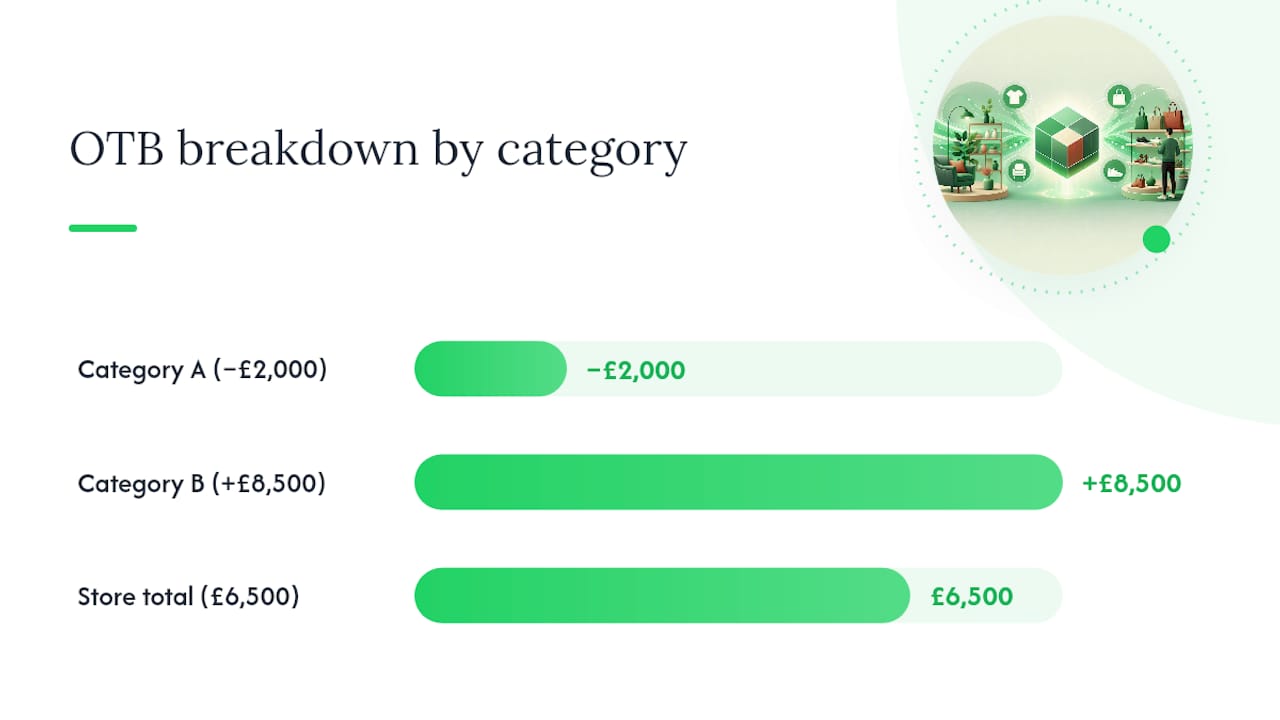
Pro Tip: Run the calculation per category before you total it for the store. A store-wide OTB of ₹65,000 can hide kurtis at minus ₹20,000 and bottoms at plus ₹85,000, and the total alone will not tell you which one needs attention.
Does GST go into the OTB calculation?
It depends on whether you can claim the GST back. Keep it consistent across all five figures either way.
- GST-registered under the regular scheme: count stock at cost before GST. The GST on your purchases comes back to you as input tax credit, so it is not part of what the stock really costs you.
- On the composition scheme, or not registered: you cannot claim input credit, so the GST you pay is a real cost. Count stock at cost including GST.
Wholesale price lists in India usually quote rates before GST ("₹499 + GST"), so check which way each supplier's figure is written before it goes into your sheet. Every style on our collections pages shows its wholesale price before GST, for example.
How should retailers build OTB into a planning process?
OTB only earns its keep as a repeatable routine, not a one-off spreadsheet. The usual order:
- Set the sales budget for the period, by category, from last year's sales plus anything you know has changed: a new location, a festival falling in a different month.
- Apply expected margins and planned markdowns, since these decide how much of that sales figure survives as usable cash.
- Set the target closing stock, usually as weeks of cover suited to the category.
- Confirm opening stock from an actual count, not an estimate.
- List stock on order: every order placed and not yet delivered.
- Compute OTB and turn the result into decisions: place new orders, delay a delivery, cancel an order, or move budget to a stronger category.
How often you recalculate matters as much as the formula. Monthly is a reasonable baseline for steady categories like basics, leggings or towels. Fast-moving fashion needs a weekly check, because one strong week or one late delivery can swing the number. New launches, festive ranges and anything on promotion often warrant a two-week check. RetailNorthstar's guidance is to recalculate whenever a sale books, an order is cancelled, a markdown is taken, or a delivery date moves, because each of those changes an input.
Pro Tip: Tie the recalculation to your ordering rhythm, not just the calendar month. If you reorder every two weeks, recalculate OTB every two weeks so buying decisions and deliveries stay in step.
For the first order with a new supplier, before you have sales history, planning your first boutique order covers how to split a budget across styles, colours and sizes.
Should you calculate OTB by department, category or channel?
A single OTB figure for the whole store hides more than it shows. One category selling fast can offset another sitting on ageing stock, and the combined number cannot tell you which lines need attention. KoronaPOS makes the case that category-level OTB is more useful than a store-wide figure precisely because planned markdowns and target closing stock vary so much between product groups: seasonal fashion needs a different markdown assumption than staple basics or towels.
Splitting a total OTB budget across categories works best when it rests on data rather than gut feel:
- Allocate by historical sales mix, giving each category a share of the buying budget in proportion to its share of sales.
- Adjust by sell-through, so categories selling faster than planned get first claim on extra OTB.
- Set a reorder rule, typically restocking proven sellers before testing new lines.
- Flag slow movers early and move their OTB elsewhere rather than leaving cash tied up in stock that is not turning.
That breakdown lets you reinvest in what is working and react to a trend before the season ends, instead of discovering the shift afterwards.
What mistakes cause OTB figures to drift from reality?
The most common failure is not a formula error but something left out. Manual OTB calculations most often miss stock on order, which overstates how much you can buy. If you have ₹90,000 in open orders and forget to subtract them, your OTB looks ₹90,000 healthier than it is.
Other recurring problems:
- Mixing cost and selling values in one calculation, which distorts the result even when every individual number is correct.
- Mixing GST-inclusive and GST-exclusive costs, the same mistake in an Indian form.
- Treating OTB as fixed, calculated once at the start of a season and never revisited as sales, deliveries and markdowns move.
- Not reconciling what you think is on order with what has actually arrived, so the on-order figure goes stale.
Pro Tip: When OTB turns negative, do not quietly place the order anyway. Cancel or push back the least important open order first, then recalculate, rather than letting the gap carry into next month.
When does OTB tracking need software instead of a spreadsheet?
A spreadsheet works for a smaller store, as long as two habits hold: accurate on-order records and a fixed recalculation rhythm you actually keep. Shopify's guidance on OTB planning notes that larger retailers benefit more from dedicated planning tools, because live data reduces the drift that creeps into manually updated sheets.
Features worth having once you outgrow a spreadsheet:
- Live recalculation whenever a sale posts or an order changes status.
- On-order reconciliation that matches orders against what has actually been received.
- Category breakdowns built in, not added as a separate tab.
- Alerts when OTB crosses zero, so nobody finds out three weeks late.
- Multi-channel reporting if you also sell online or through a marketplace.
For a store with one or two people buying across a handful of categories, a well-built spreadsheet with strict update habits gets you most of the way.
Keeping stock on order accurate
Missing stock on order is the biggest single source of OTB error, and the fix starts with how you place orders. Fewer, larger orders that sit open for weeks are harder to track than smaller, more frequent ones that arrive and get logged.
Three things help:
- Smaller, more frequent orders are easier to log and reconcile than one large delivery.
- Ordering in writing (WhatsApp or email) gives you a dated record of what was ordered, which makes the on-order line easy to keep up to date.
- Suppliers without a minimum order let you top up a category exactly when OTB shows room, instead of over-ordering to reach a threshold.
Mai Lady works this way: there is no minimum order on our catalogue styles, every style shows its wholesale price before GST, and orders are placed on WhatsApp. If you are rebuilding your buying around a live OTB number, the collections show what is currently in the range.
Why OTB discipline takes longer to embed than the formula suggests
The arithmetic behind open to buy is simple. Using it week after week is the hard part. It usually takes a season or two before sales, accounts and buying are working from the same numbers instead of separate notebooks and sheets. Start with a monthly figure for the whole store, get the habit right, then move to category-level and tighter cycles once the basics stick. Trying to run a perfect five-category weekly OTB from day one is how most stores give up on it within a month.
Sources
Frequently asked questions
What does "open to buy" mean in retail?
Open to buy is the amount you can still spend on new stock for a period after subtracting current stock and everything already on order. It is a spending ceiling, not a target to hit.
What is the open to buy formula?
OTB = planned sales + planned markdowns + planned closing stock − opening stock − stock on order. Keep every figure at either cost or selling value, never both.
What is an example of an OTB calculation?
For a month with ₹1,80,000 planned sales, ₹15,000 planned markdowns, ₹2,20,000 target closing stock, ₹2,60,000 opening stock and ₹90,000 already on order, OTB is ₹65,000 available for new orders.
Should GST be included in open to buy?
If you are GST-registered under the regular scheme, use costs before GST, because you claim it back as input tax credit. On the composition scheme or unregistered, include GST, because it is a real cost to you. Either way, keep all five figures consistent.
What happens when OTB is negative?
A negative OTB means your stock and open orders already exceed the plan, so cancel or delay orders and reforecast rather than placing new ones.
How often should retailers recalculate OTB?
Monthly works for steady categories, fast-moving fashion usually needs a weekly check, and festive or promotional ranges often warrant every two weeks.
Buying for your store this season?
More guides
- Starting a kurti brand: how to get your own designs manufacturedA manufacturer can only quote what you can describe. Here is what to put together before your first message, so the reply you get back is a real rate and not a list of questions.
- Stocking plus-size kurtis: a wholesale buying guide for retailersThe customer who cannot find her size in your store does not come back to check. The one who does find it tells her friends. Here is how to stock 3XL and above without guessing.
- 5 Fabric Pilling Test Methods for Lab Technicians and When to Use EachA fabric pilling test measures how readily a textile forms those small fuzzy balls on its surface after rubbing or abrasion. The main method families are the Martindale test, random tumble (ICI/pilling box), brush pilling, elastomeric pad, and circular locus, each governed by an ASTM or ISO standard. Which one you choose depends entirely on the fabric's end use, from knitwear to upholstery.