5 Fabric Pilling Test Methods for Lab Technicians and When to Use Each
TL;DR:
- Different pilling test methods simulate specific real-world wear scenarios; choosing the appropriate one depends on the fabric's end use.
- Variations between testing methods can produce different results, making it essential to agree on protocols and relevance before testing.
- Pilling resistance is heavily influenced by fiber length, yarn twist, fabric density, and finishing processes, especially for blended fibers.
- Laboratory pilling tests are predictive rather than definitive and should be used alongside other durability assessments for accurate quality judgment.
- Consistent test preparation, training assessors, and clear documentation are critical for comparable and reliable pilling results over time.
Table of Contents
- Why does fabric pilling matter and what causes it?
- What are the standard fabric pilling test methods?
- How do you prepare and run a pilling test?
- How is fabric pilling rated and reported?
- Which pilling test suits your product category?
- What are the limitations of laboratory pilling tests?
- Bringing pilling testing into routine quality control
- The method matters more than the machine
- Sources
- FAQ
Why does fabric pilling matter and what causes it?
Pilling isn't the same as fuzzing. Fuzzing is loose fibre ends standing proud of the surface; pilling happens when those fibres tangle into small balls that cling on through friction and static, rather than shedding away. A garment covered in fuzz might still look tidy after a wash. One covered in pills looks worn out, and that visual judgement is what customers actually act on.
Several material factors drive the tendency to pill:
- Short staple fibres migrate to the surface more easily than long ones.
- Weak fibres let pills form, but if they're blended with a strong fibre (polyester with cotton, for instance), that stronger fibre anchors the pill instead of letting it break off.
- Tight yarn twist resists pilling better than loosely spun yarn.
- Dense, closely woven or knitted structures show less pilling than loose ones.
- Certain finishing agents and singeing treatments reduce the free fibre ends available to pill.
Blended constructions combining strong and weak fibres are especially prone to pilling because the weak fibre forms the pill and the strong fibre refuses to let it go. Pilling resistance rarely sits in isolation. Any full durability assessment should sit alongside abrasion resistance, seam slippage and colourfastness testing, because a fabric that scores well on pilling can still fail elsewhere.
What are the standard fabric pilling test methods?
Five method families cover almost every commercial pilling evaluation, and each simulates a different kind of real-world abrasion.
- Martindale (ASTM D4970 / ISO 12945-2). The specimen moves in a figure-of-eight, elliptical path against a wool abradant or another test fabric, typically run to a set number of cycles depending on the fabric type. It's the most widely used method and reproduces the multidirectional rubbing a fabric experiences in genuine wear, from cuffs against a desk to a seat against trousers.
- Random tumble pilling tester (ASTM D3512 / ISO 12945-3). Specimens tumble inside a rotating, cork-lined chamber, usually with a set amount of cotton fluff added to accelerate pill formation. This mimics laundering and general wear far better than a fixed rubbing motion, which is why it's the preferred method for knitted apparel.
- ICI pilling box (EN ISO 12945-1). Specimens are mounted on rubber tubes and tumbled inside a box lined with cork. It's mechanically simple and cheap to run, which explains its long history as a general-purpose screening test even where it isn't the most representative option.
- Brush pilling tester (ASTM D3511). A rotating brush drum abrades the fabric aggressively, which suits upholstery and automotive textiles that face far harsher surface contact than clothing ever does.
- Elastomeric pad (ASTM D3514) and circular locus methods. A rubber pad rubs the fabric in a fixed circular or oscillating path. Both are useful for knits and speciality constructions where the standard Martindale abradant doesn't behave consistently.
Different methods rarely agree with each other. Martindale testing often produces higher measured pilling than other methods (https://ecostandard.org/resources/report-deep-dive-standards-to-measure-textile-durability/), and comparative studies show real variation in repeatability across the five families. That's exactly why ASTM D4970 itself cautions against using some of these methods for acceptance testing without an agreed protocol between buyer and supplier. Never assume a passing Martindale result guarantees a passing brush-test result on the same fabric.
How do you prepare and run a pilling test?
Sample preparation determines whether your results mean anything. Follow these steps in sequence:
- Condition specimens at 20°C ±2°C and 65% ±2% relative humidity for at least 24 hours before testing, per standard textile conditioning practice.
- Cut the required number of replicates, typically a minimum of three to five per fabric, avoiding folds, selvedges, or visible defects.
- Mount specimens according to the method's convention. Flat mounting suits Martindale; tube mounting suits ICI box and random tumble testers.
- Set the cycle or rub count specified by the standard for the fabric weight and type, then run without interruption unless the method calls for interim inspection.
- Check the abradant condition before each run. Wool felt and cork liners wear out and need replacement at the intervals your equipment manufacturer specifies, or results drift over time.
- Record whether the specimen was tested as received, after laundering, or after dry cleaning. Standards recommend stating this explicitly, since finishing and refurbishment substantially change pilling behaviour.
Pro Tip: Keep a conditioning room log alongside your test records. If a result looks anomalous months later, humidity drift on the day of testing is one of the first things worth ruling out.
How is fabric pilling rated and reported?
Pilling is assessed against a five-to-one visual scale: 5 means no pilling, 1 means very severe pilling, with 2, 3, and 4 marking the steps between. Assessors compare the tested specimen against photographic replica standards under controlled, consistent lighting, usually against a neutral grey background.
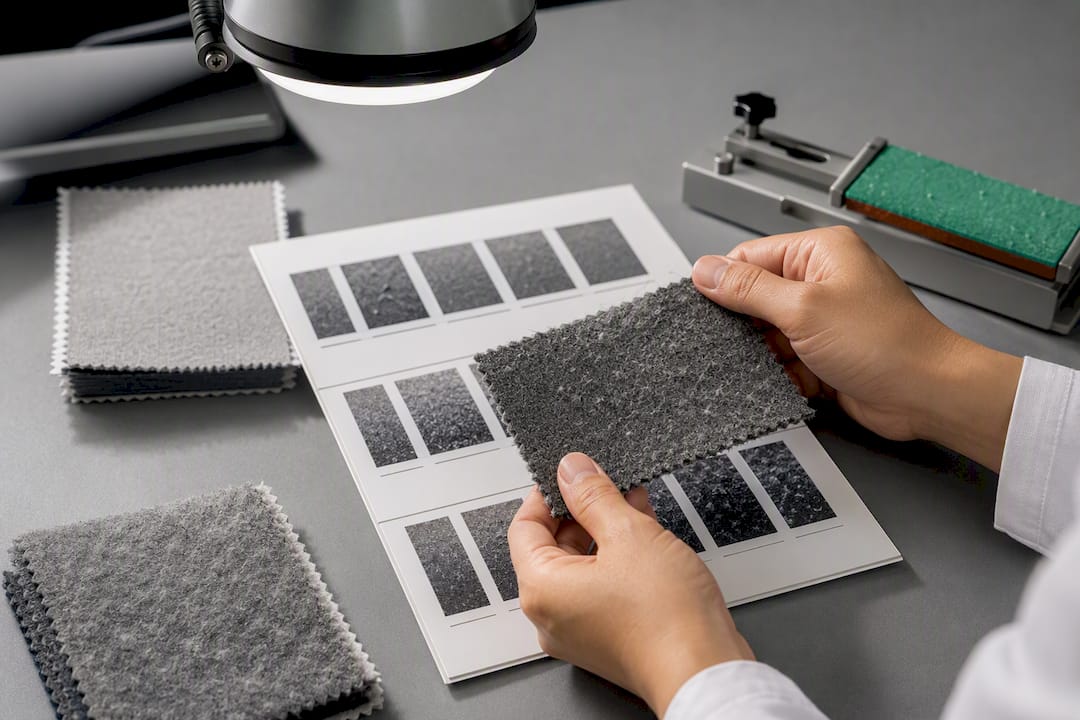
Good practice calls for more than one trained assessor working independently, then reconciling scores, rather than a single technician making the call. Blinded comparisons against reference photographs reduce the subjectivity that plagues single-assessor ratings. Counting individual pills is generally discouraged, since pill size and density vary too much for a raw count to mean anything on its own. It only becomes useful for very specific research comparisons where visual rating alone can't distinguish two similar samples.
A concise report should state: the method used, cycle count, specimen state (as received or laundered), the rating achieved, and any secondary surface changes such as fuzzing or colour change.
Which pilling test suits your product category?
Match the test to the abrasion the product will actually face in service, not to whichever machine happens to be free in the lab.
- Apparel and knitwear: random tumble or ICI box, since both reproduce laundering and everyday wear far better than a fixed rubbing path.
- Upholstery and automotive textiles: brush pilling or Martindale with an appropriate abradant, depending on how aggressively the surface gets rubbed in service.
- Tightly woven technical fabrics: Martindale or the elastomeric pad, chosen based on which reproduces the expected contact pattern.
Agree acceptance criteria and test state with commercial partners before testing begins, not after a batch fails. ACT performance guidelines set a class 3 minimum under ASTM D3511 or D4970 for contract upholstery, which is a useful benchmark if your own specification doesn't set one. When a fabric sits between categories, such as a heavyweight knit destined for both apparel and soft furnishings, running two complementary tests brackets the likely real-world result better than trusting a single method.
What are the limitations of laboratory pilling tests?
No pilling machine fully replicates real wear. Laboratory tests are predictive rather than absolute: actual performance depends on cleaning habits, how a garment is worn, furniture construction, and dozens of other interacting variables no test rig captures.
Inter-laboratory precision for pilling tests has historically been poor, which is precisely why standards recommend treating results as comparative within one lab rather than as a universal pass or fail figure for a shipment.
- Use photographic standards consistently across every assessment, not just occasionally.
- Train assessors and check agreement between them periodically.
- Agree the test protocol and acceptable rating with your commercial partner before goods ship.
- Validate lab ratings against samples that have seen genuine in-service wear whenever you can.
Pro Tip: If a buyer disputes a pilling result, ask which method and cycle count they tested against before arguing the number. Different labs running different standards on the same fabric can legitimately produce different ratings.
Bringing pilling testing into routine quality control
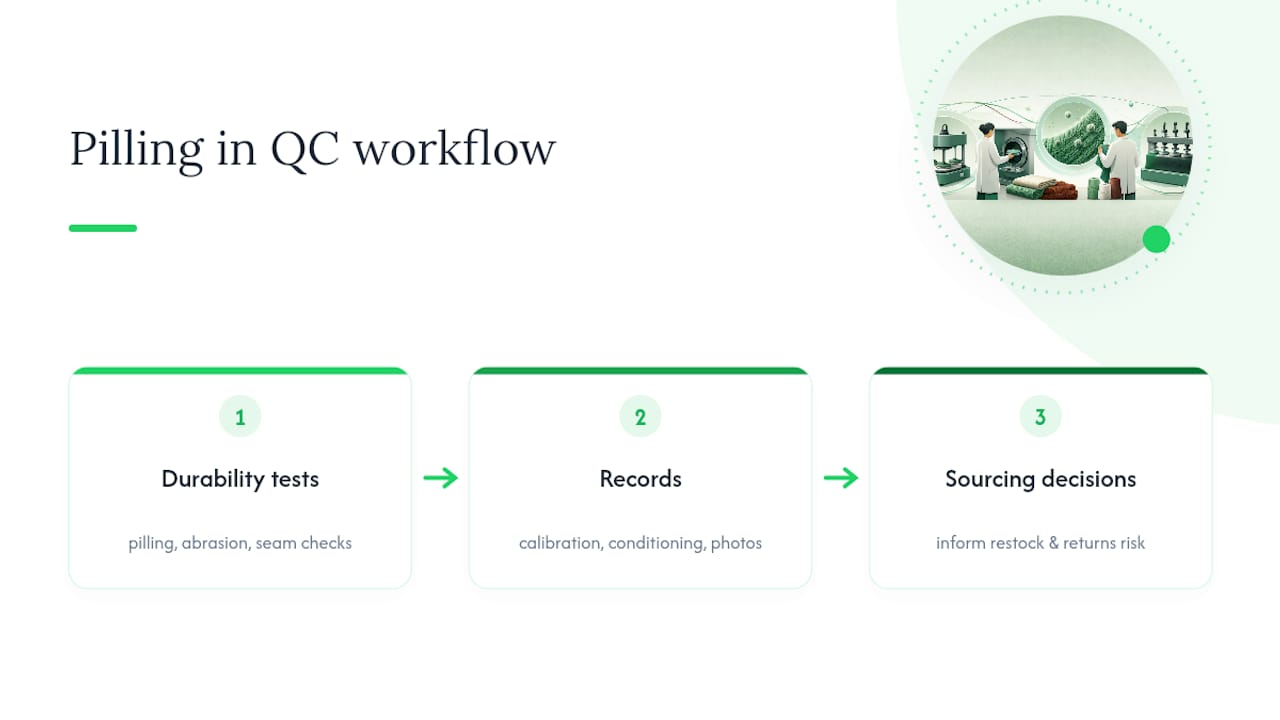
Labs get the most value from pilling data when it sits inside a broader durability profile, paired with abrasion and seam strength checks rather than run in isolation. Routine calibration, conditioning room logs, and consistent photographic standards keep ratings comparable month to month. Sourcing decisions for restocked lines often lean on this kind of durability thinking, since a fabric that pills within weeks costs a retailer far more in returns than it saves on the unit price.
The method matters more than the machine
Most guidance on pilling still treats it as a single number to chase, as though a Martindale rating of 4 means something fixed and universal. It doesn't. The conventional advice skips over the fact that different methods measure different kinds of abrasion, and a fabric can score well on one and poorly on another without either result being wrong.
What the standards actually support is narrower and more useful: pick the method that reproduces how the fabric will really be handled, agree the acceptance rating with whoever you're selling to before you test, and treat the number as a comparison tool rather than a certificate. Students and technicians who learn the five methods as interchangeable options usually skip the harder, more valuable skill, which is matching test to end use. That judgement call, not the abradant or the cycle count, is where most commercial disputes over "poor quality" fabric actually originate.
If there's one habit worth building early, it's documenting the fabric's state at test time. As received or laundered changes the result more than most technicians expect, and it's the detail most reports leave out.
Abhishek Sanghvi
Sources
- Test Methods and Finishing Methods of Fabric Pilling - TESTEX
- D4970/D4970M Standard Test Method for Pilling Resistance and Other Related Surface Changes of Textile Fabrics: Martindale Tester
- Predictive limits of laboratory textile testing (peer-reviewed article)
- ACT performance guidelines (physical properties for contract textiles)
Frequently asked questions
What does the ASTM D5034 test method actually measure?
The grab test measures fabric breaking strength and elongation under tension. It's a separate durability test from pilling and is typically run alongside pilling and abrasion tests for a complete strength and surface-wear profile.
What is the procedure for an ICI pilling test?
Specimens are mounted on rubber tubes and tumbled inside a cork-lined box for a set number of revolutions, then rated against the five-to-one visual scale under controlled lighting. It's a simpler, lower-cost screening method compared with Martindale or random tumble testing.
Does pilling mean poor fabric quality?
Not necessarily. Pilling relates to fibre type, yarn twist, and fabric construction as much as manufacturing quality, so a low pilling rating on one method doesn't automatically mean the fabric is poorly made, only that it responds differently to that specific abrasion pattern.
What is the four-point system for fabric inspection?
The four-point system is a fabric grading method used to count and score visible defects such as holes, stains, and weaving faults during quality inspection. It's distinct from pilling assessment, which uses the separate five-to-one visual pilling scale rather than a defect-point count.
Buying for your store this season?
More guides
- Avoid a False £6,500 Green Light: Make Open to Buy Work in RetailOpen-to-buy is the amount of stock, in cost or retail pounds, you can still purchase for a period once your current inventory and everything already on order are accounted for. A positive figure means you have room to commit new purchase orders. Zero means hold your position. Negative means stop, cancel or delay orders, and reforecast before you buy anything else.
- MOQ, sets and catalogues: how minimum orders really work in Indian wholesaleMost MOQ advice online is written for American boutiques buying from American vendors. Here is how minimums are actually counted when you buy ladies wear in India, and what each way of counting does to your cash.
- How to choose a wholesale clothing supplier in India: 12 questions before your first orderAnyone can send you a good photo and a low rate. These are the twelve questions that tell you whether a supplier will still be worth buying from on your fourth order.